
Haiti's reliance on wood charcoal for everyday cooking has become an environmental emergency — and an economic one. The numbers, drawn from a 2018 World Bank national assessment, are stark.
Decades of charcoal production have stripped the land. Today roughly 30% tree cover remains — and continued wood-charcoal demand keeps the pressure on.
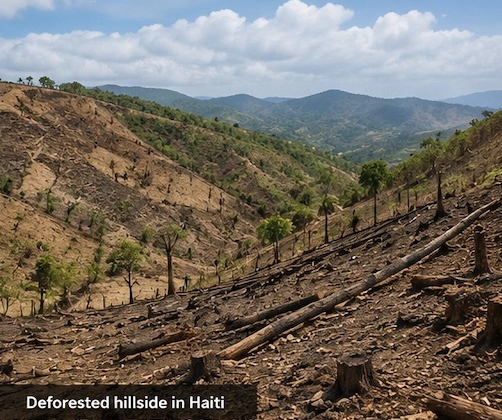 Photo — deforested hillside / charcoal kiln in Haiti
Charcoal sales represent roughly 5% of Haiti's entire GDP — which is what makes the trade so hard to displace, and so valuable to get right.
Charcoal sustains a quarter-million livelihoods — yet the way it's made is consuming the very forests Haiti depends on. The opportunity isn't to ban it. It's to make it sustainable.
EkoAyiti — informed by the World Bank's Charcoal in Haiti: A National Assessment (Nov 2018)
Replace wood charcoal with charcoal made from agricultural waste, and the same market that's destroying Haiti's forests can start protecting them.