
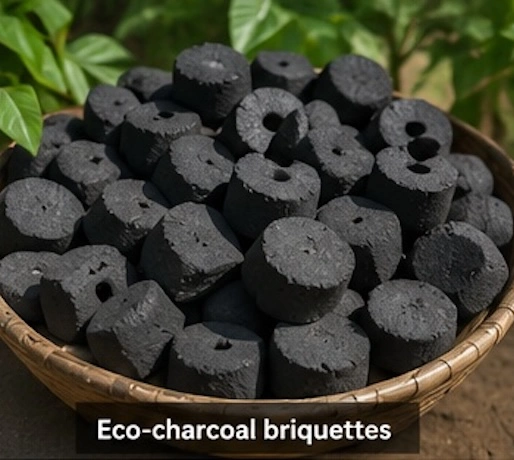
 Photo — eco-charcoal briquettes
Available now
Eco-Charcoal
Our first product — replacing wood charcoal with a cleaner, cheaper, renewable alternative.
We turn agricultural waste into ecological charcoal — a non-toxic, smokeless, longer-burning fuel that costs less, protects Haiti's forests, and replaces the wood charcoal driving deforestation.
Photo — eco-charcoal briquettes / production in HincheMore than 80% of households rely on wood charcoal for daily cooking — fueling an annual loss of roughly 30 million trees and accelerating one of the world's most severe deforestation crises.
EkoAyiti's eco-charcoal is produced from agricultural waste — an abundant, renewable resource. It burns cleaner, lasts longer, and costs less than wood charcoal, with no smoke and no felled trees.
Crop residues and agricultural waste are gathered from local farms — turning a disposal problem into raw material.
Waste is carbonized and compressed into clean briquettes — non-toxic, smokeless, and engineered to burn longer.
Briquettes reach households and small businesses through local vendors and community partners — affordable and accessible.
Eco-charcoal is our launch product. From there, EkoAyiti expands across the renewable-energy stack — building an integrated clean-energy company rooted in Haitian communities.
Photo — eco-charcoal briquettesOur first product — replacing wood charcoal with a cleaner, cheaper, renewable alternative.
 Photo — efficient charcoal stove
Efficient stoves designed to maximize the benefits of ecological charcoal.
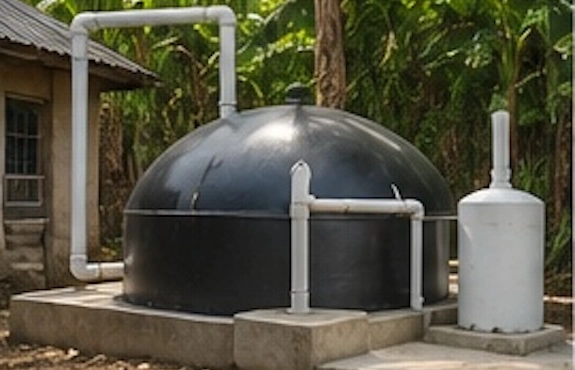 Photo — biogas / solar / wind
Affordable solar, wind projects, energy storage, and agriculture that feeds the supply chain.
Replacing wood charcoal does more than protect forests — it lowers emissions, creates rural jobs, and improves health in homes where smoke is a daily reality.
Our impact model →EkoAyiti is raising $75,000 for 15% equity to launch production in Hinche. Year-5 revenue is projected at $29.2M as we scale across Haiti.
Investors, partners, vendors, and supporters — connect, share progress, and follow the impact in the EkoAyiti community.